
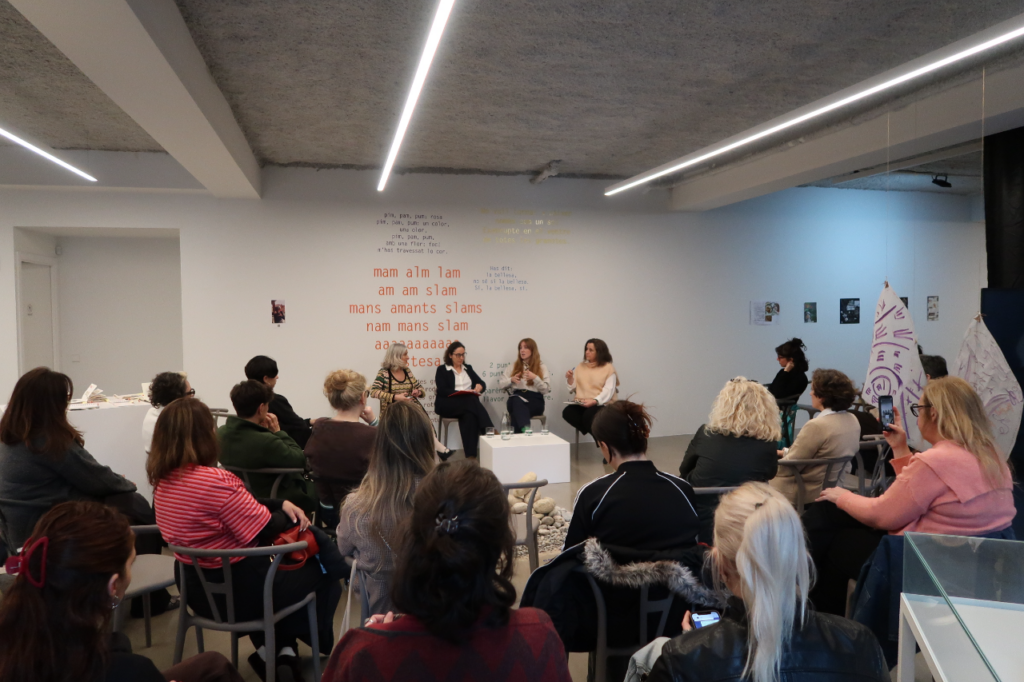
Moderated by María Gracia de Pedro, Founder and Director of Artepreneur, the event brought together Natalia Foguet, Director of Fundació Úniques; Carolina Grau, independent curator and art critic; and Isabel Niño, co-founder, partner, and lawyer at Nial Art Law, a boutique law firm highly specialized in the art market.
The discussion focused on how different professional figures accompany, support, and articulate the work of artists, both during the conceptual phase and in the projection and commercialization of their work. It offered a reflection on the relationships, mediations, and support structures involved in contemporary artistic practice, highlighting the dialogue between creation, institutional context, market, and legal framework.
The session began with a presentation of Fundació Úniques by Natalia Foguet, who explained how the foundation supports women artists who live and/or develop their practice in the Catalan Countries. From this position, she outlined the institution’s core values, centered on creating both a physical and conceptual space for representation, support, and collective work, as well as promoting more equitable collecting practices.
Carolina Grau then shared her experience working closely with artists through her curatorial practice, emphasizing the importance of studio visits and residencies as key tools to better understand and expand perspectives on contemporary artistic practices. She also encouraged artists to actively communicate their projects and activities, facilitating connections with curators and other professionals in the field.
Isabel Niño addressed the topic from a legal perspective, noting that many artists still accept unfavorable conditions due to a lack of information or allow their images to circulate in digital environments without proper control. She stressed that specialized legal advice in the art market is no longer a luxury but an essential tool to protect artistic work, ensure fair compensation, structure professional activity, diversify income streams, and build a sustainable career while avoiding complex and costly mistakes.
From these three perspectives —institutional, curatorial, and legal— the discussion highlighted how, when working in dialogue, these areas significantly contribute to the development of artistic careers.
The conversation was further enriched by the participation of an audience composed mostly of women artists, whose questions reflected a strong interest in understanding possible career paths, as well as the challenges and decisions encountered throughout their professional trajectories.
The speakers agreed that while the artist remains the creative core, professional support—particularly in administrative and legal areas—is key to ensuring that the work reaches its audience and to preventing future challenges.
The session concluded with a shared reflection: the contemporary art sector is shaped not only by what is created, but also by how it is supported. In this context, building strong and continuous professional relationships remains one of the most valuable elements of the ecosystem.
*Special thanks to Colet & Shida