
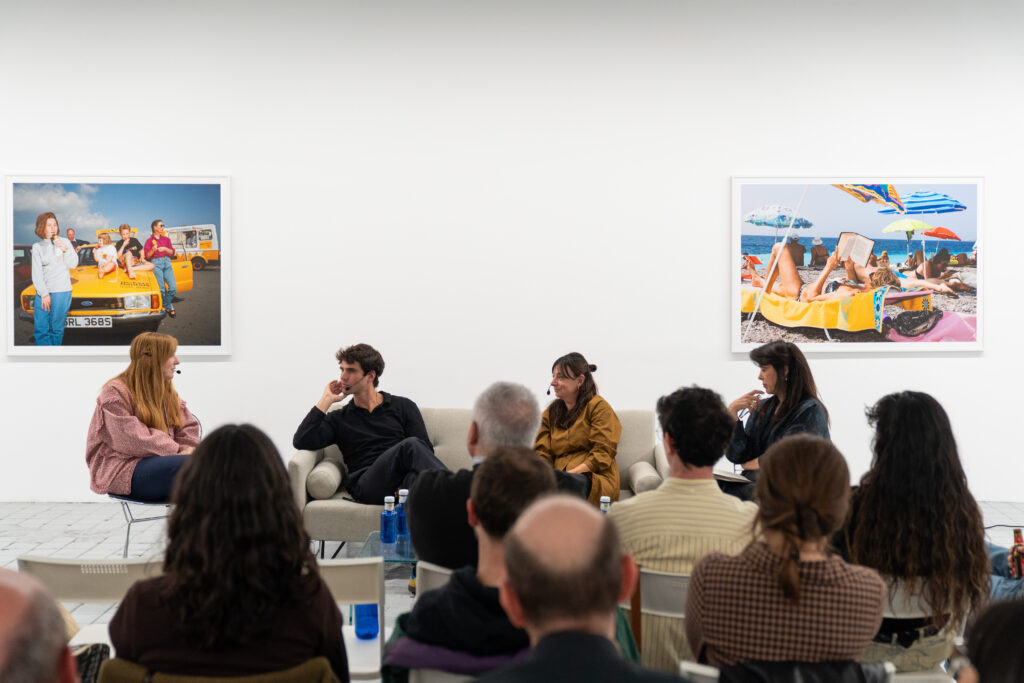
Last Tuesday, 20 October, we held the tenth edition of Laberintos del Sector. Entitled The Visual Narrative: From Idea to Exhibition Space, the event took place at Galería Marc Bibiloni in Madrid. It was held in conjunction with A Matter of Taste, an exhibition by British photographer Martin Parr.
During the discussion, we explored the processes and decisions involved in bringing an exhibition to life. We also reflected on the roles of the different professionals who contribute to each project.
The session was moderated by María Gracia de Pedro, founder and director of Artepreneur. The speakers were Marc Bibiloni, gallery director; Paz Guadalix, cultural manager; and Ana Belén García Mula, curator and exhibition project manager. Each shared their experience from a different professional perspective.
From Idea to Installation: Building an Exhibition
Marc Bibiloni explained how an exhibition project takes shape from a gallery’s perspective. He focused on the decisions involved in selecting and presenting artworks.
One of the main challenges of A Matter of Taste was bringing together six different photographic series. The aim was to ensure that their colours and compositions worked together as a coherent whole.
Although the initial intention was to simplify the exhibition, the installation required careful planning. The team had to consider the relationships between the images, their sizes and their placement. To anticipate the final result, Bibiloni uses digital renderings to visualise the exhibition before installing the photographs.
He also highlighted the value of the shared experience of visiting a gallery. It allows visitors to exchange impressions, discuss artworks and discover new interpretations.
Cultural Management and Working with Artists
From a cultural management perspective, Paz Guadalix emphasised the importance of organising and coordinating every stage of a project. Bringing an idea into the exhibition space requires careful scheduling, resource management and teamwork. It is also essential to know how to respond to unexpected challenges.
Paz also highlighted the importance of supporting artists, particularly those at the beginning of their careers. This guidance helps them build confidence as they develop their projects.
In this regard, the discussion underscored the need to respect each professional’s responsibilities. Collaboration between artists, curators and cultural managers is essential to the successful development of an exhibition.
Accessibility and sustainability were also addressed. Key topics included the layout of exhibition spaces, the provision of seating and the use of clear, accessible texts. These measures help make exhibitions more welcoming to audiences with different needs.
Curating: Building a Visual Narrative
Ana Belén García Mula reflected on the role of curating in shaping an exhibition’s narrative. The selection and sequence of artworks determine how the story unfolds. Likewise, the arrangement of the pieces influences how visitors interpret the exhibition as a whole.
Other elements also shape the visitor’s experience. These include wall texts, lighting and exhibition design.
In Martin Parr’s work, the selection of photographs is essential to developing a particular perspective on society and everyday life. Alongside artistic and curatorial knowledge, García Mula highlighted other important skills, including problem-solving, adaptability and team coordination.
These abilities are particularly valuable in projects involving professionals from different backgrounds and contexts.
Audience Questions: The Photography Market, Installation and Value
The audience Q&A provided an opportunity to explore several aspects of the photography market. One question concerned whether photography is becoming less visible at art fairs, particularly in Spain.
In response, Marc Bibiloni explained that the visibility of photography shifts with changing trends. Art fairs reflect the interests of each period, while their high costs can also influence gallery decisions.
Another question focused on how the value of Martin Parr’s photographs has changed since his death. Bibiloni explained that several factors influence the value of an artwork, including its certification, edition size and exhibition history. He also noted that interest in Parr’s photographs has increased since his passing.
Finally, attendees returned to the challenges of installing A Matter of Taste. Careful planning of the photographs’ placement and dimensions was essential to achieving a visually coherent result.
The discussion highlighted how technical and spatial decisions are also integral to an exhibition’s narrative.
An Exhibition: A Collective Effort
This tenth edition of Laberintos del Sector offered insight into the work behind an exhibition. It also highlighted the diversity of professionals involved in bringing one to life.
Planning, communication and technical knowledge are essential throughout the process. These skills go hand in hand with problem-solving and artistic sensitivity. Together, they help transform an initial idea into a fully realised exhibition.
Through this event, Artepreneur continues to create spaces for dialogue about careers and professional roles in the arts and cultural sector. In doing so, it highlights the skills, responsibilities and collaborative work that make the experience of art possible.