
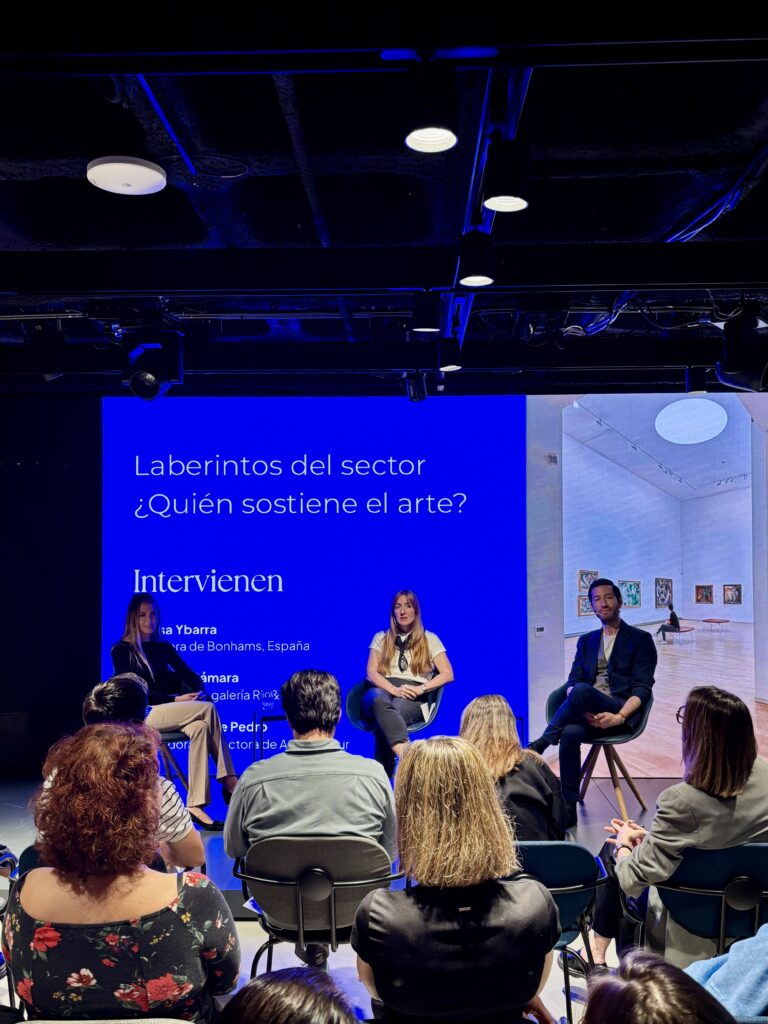
The session was introduced by María Gracia de Pedro, director and founder of Artepreneur, who thanked both attendees and the hosting venue before raising the central question of the event: art does not sustain itself alone, but rather within a complex network of agents, decisions, and relationships that allow artworks to be produced, circulated, and consolidated.
On this occasion, the conversation was structured around two fundamental perspectives within the system: art galleries and auction houses, represented by Gregorio Cámara, director of RIO & MEÑAKA, and Teresa Ybarra, director of Bonhams in Spain.
Gregorio Cámara opened the discussion by addressing the role of galleries in the development of an artist. Far from being limited to exhibition, he emphasized how galleries build long-term careers by defining coherent curatorial lines and fostering sustained relationships with collectors and institutions.
He also highlighted the strategic dimension of their work: participation in art fairs, international collaborations, and the consolidation of networks that position artists within a global context. Galleries emerge as spaces of continuous support, where the relationship with the artist goes beyond exhibitions and becomes a long-term collaboration.
From the perspective of the secondary market, Teresa Ybarra offered her insight from within Bonhams, explaining how an auction house operates, the role it plays in consolidating the value of artworks, and detailing how auctions function, including who can participate.
Beyond the sale itself, she underscored the importance of research, expertise, and contextual analysis in setting prices and building trust in the market. One of the central themes was the reflection on the value of an artwork: a complex combination of history, context, and market dynamics. In this framework, the evolution of the contemporary collector was also addressed, marked by the emergence of new profiles and new ways of engaging with art.
Both speakers agreed on the growing importance of Madrid as an increasingly relevant node in the international art map, partly driven by fairs such as ARCO and by the rising interest of global collectors, while also pointing out certain structural challenges that continue to shape the local context.
The conversation led into a dynamic exchange between the speakers, exploring the relationships between galleries and auction houses as parts of the same ecosystem. Key topics included the limits of each role in the life of an artwork, recent changes in the sector—driven by digitalization and new forms of collecting—and the role of the private sector in cultural development.
The Q&A session further expanded the debate, opening new lines of reflection with contributions focused on issues such as cultural VAT, the fate of unsold works, valuation criteria, and the presence of Spanish galleries both in national fairs and in the international circuit.
The event concluded by reinforcing a fundamental idea: contemporary art is sustained by a network of agents who, from different fields, make its existence, circulation, and permanence possible. With this edition, Laberintos del Sectorreaffirms its role as a space for thought and dialogue to better understand, from within, the dynamics that shape today’s art world.