
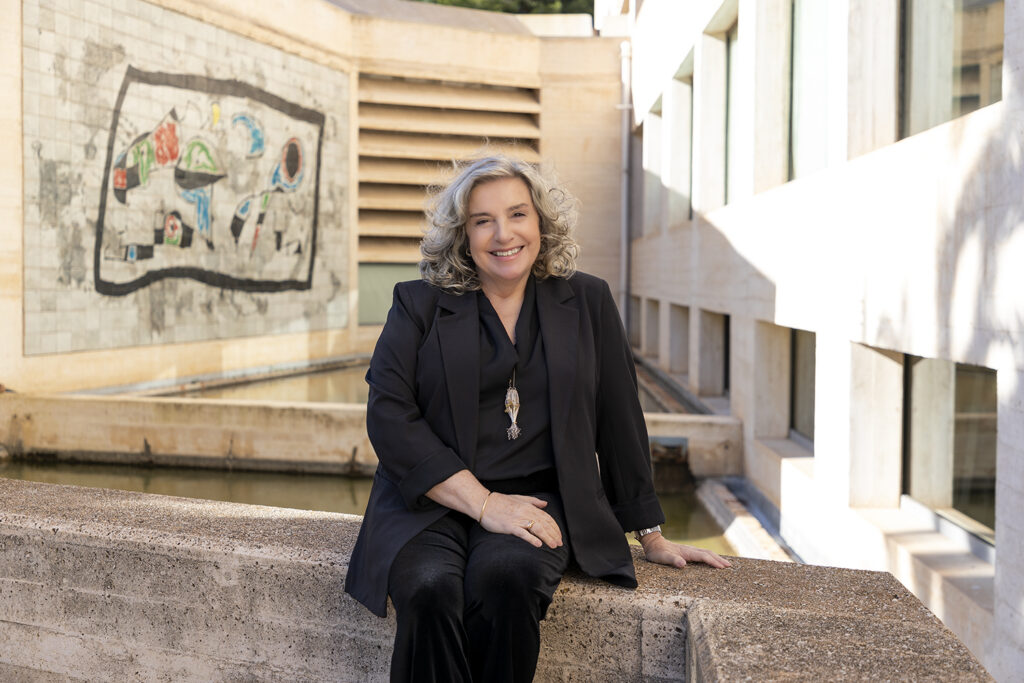
What are your main responsibilities in your current role?
My main work at the Fundació Miró Mallorca involves thinking about the programming as a whole, encompassing everything from temporary exhibitions to film, music and public programmes. As director-manager, I handle budget management and set strategic priorities for the institution, but I also oversee the conservation of a complex architectural heritage of three buildings. I am currently supervising the major renovation work at Son Boter, where we are working on the roof, beams and drainage to preserve Miró’s original graffiti. I have also driven the sculpture garden, which has grown from six to eleven monumental pieces, and launched the foundation’s “Friends” programme, successfully drawing the local public back in with dynamic activities and contemporary landscaping days.
How has your professional background prepared you for your current role, and what has been your biggest challenge?
I began my academic career as a lecturer in Baroque architecture at the University of Barcelona before moving to the exhibition services of Barcelona City Council at the Palau de la Virreina. One of my first major challenges was coordinating exhibitions in Japan during the 1980s, a brilliant era in which we managed the entire process, from the catalogue to the logistics of transporting works on cargo jumbo jets. I later had the opportunity to work on the prefiguration of MACBA alongside Jean-Louis Froment, which led me to live in Bordeaux to learn how a museum is structured as an institution. The greatest professional challenge of my life was managing the MACBA collection from its very beginning. When I joined, we had only fourteen random pieces, and after years of work navigating changes in direction and criteria, I managed to grow the collection to over six thousand works, always maintaining a coherent vision.
What keeps you inspired and informed in a career that is in constant evolution? What platforms do you use to stay informed?
My inspiration is constant because I have no other interest outside of art. I enjoy every phase of the process, from organising and conceiving an exhibition to finally seeing it in the gallery. To stay current, I regularly visit international fairs and major events such as Documenta or the biennials. Teaching has also been a key tool in my development; I have lectured for thirty years at institutions such as the UB, UIC and Pompeu Fabra, which compels me to research and remain in a state of continuous learning. I also place great value on the leadership and management courses I have taken throughout my career, as they have given me the tools needed to manage teams and set priorities during times of change.
What abilities do you think have contributed to the success you have in your career today?
I believe persistence and constant curiosity about the world of creation have been the fundamental drivers of my success. I have always been very persistent because I understood from the outset that nobody was going to come looking for me at home and that I had to earn every opportunity. I would also highlight organisational ability and adaptive leadership as essential skills. Through my training in team management, I learned to recognise that people are different. While some professionals need complete freedom, others require more direct guidance. Understanding these dynamics has allowed me to coordinate complex teams in high-level institutions, always ensuring the artistic project moves forward.
What advice would you give to someone who is starting their career?
To anyone just starting out in this sector, I would say: never lose your curiosity and seek the most complete education possible. Mastering languages is essential, they are the tool that opens doors at unexpected moments. I also consider it vital to build networks and nurture personal relationships; you never know when you will create a synergy or when you might give or receive help. Finally, I would advise them to be very persistent and to maintain an open attitude to every stimulus. I started out fascinated by Egypt and ended up in contemporary art. What matters is getting involved in what truly interests you and understanding that the real school, beyond formal study, is throwing yourself into projects and learning from each of their phases.