
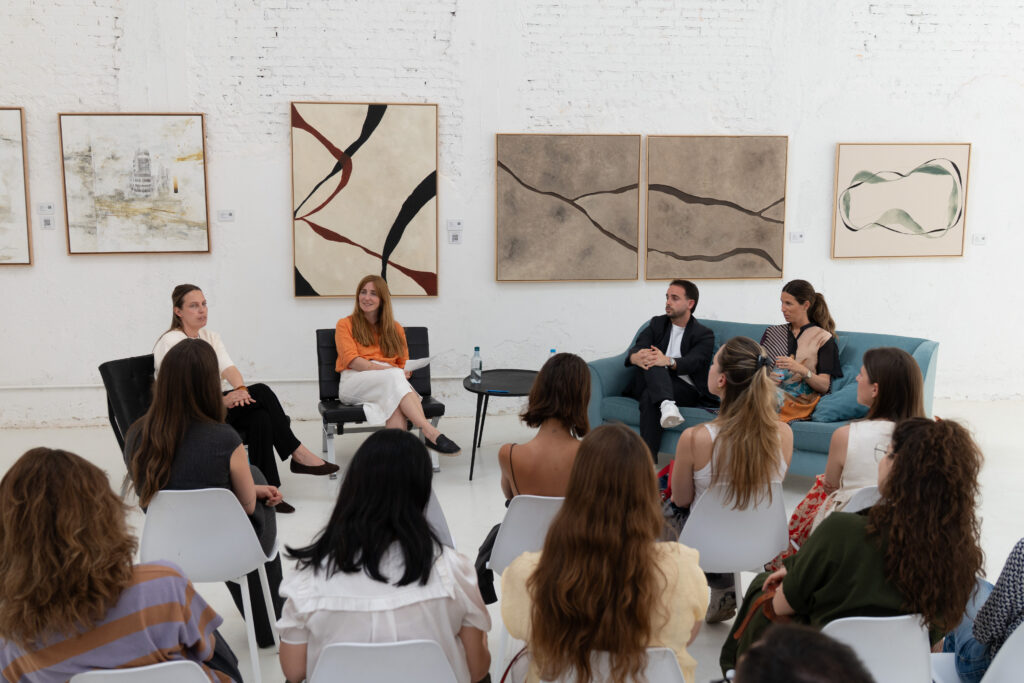
On May 21st, the eighth edition of Laberintos del Sector took place at the Argén space in Madrid, organized together with Helarea under the title Between Logistics, Interior Design and Art. The conversation revolved around the relationships between logistics, interior design and artistic practice, focusing on the processes, collaborations and challenges that intersect across these fields within the contemporary cultural context.
The session was introduced by María Gracia de Pedro, director and founder of Artepreneur, who thanked Helarea for their collaboration in organizing the event and the attendees for joining. Before introducing the speakers, she presented the central idea that would guide the discussion. When we think about the art world, we often focus on creation, galleries or collecting; however, there are many other essential professionals who make it possible for artworks to reach spaces and become part of people’s lives.
This conversation aimed to make that process visible through three complementary perspectives: interior design as a discipline that dialogues with art and builds spaces through it; art sales as a model that transforms the relationship between artwork, space and audience; and logistics as an essential structure for the transportation, conservation and installation of artworks.
The panel featured Belén Cabido Aresti, CEO of Helarea; María Heiskanen, founder and creative director of Dear Studio; and Imanol Palacios, founder of EnviArte.
Belén Cabido Aresti opened the discussion by presenting Helarea, a project through which she promotes a new way of understanding contemporary art: more accessible, closer to people and deeply connected to interior design. During her intervention, she emphasized how an artwork can transform an environment and give it identity, highlighting that Helarea has become a gateway to art for people approaching it for the first time, whether in homes, offices, hotels or corporate spaces.
Imanol Palacios focused his intervention on everything that happens before an artwork reaches its destination: packaging, transportation, installation, and the conservation and internationalization challenges involved in moving art pieces. As founder of EnviArte, he explained that he created the company to professionalize a part of the sector that had remained in the background for too long, emphasizing that trust among all agents involved in the process — artists, galleries, interior designers and collectors — is just as important as the logistics execution itself.
María Heiskanen contributed the perspective of interior design and creative direction through Dear Studio, a Madrid-based studio working at the intersection of aesthetics, branding, culture and experiences. She reflected on the moment when artworks enter into the construction of a space and how the client’s identity shapes every decision, while also pointing to the evolution of this relationship as clients develop a deeper aesthetic awareness and a genuine interest in contemporary art.
Following these initial interventions, the discussion moved into one of the richest moments of the encounter. The three speakers explored how their professional profiles interact within a real project and at what stage each one begins collaborating in the process. It became clear that early coordination between interior designers, art advisors and logistics specialists makes a decisive difference to the final result.
The conversation also addressed how the way people integrate art into their spaces has evolved — with a growing tendency toward personalization and meaning — the value that art brings to private, corporate and public environments, and the main challenges currently faced when working with art outside the traditional exhibition context. One of the questions that generated the most debate was whether art has become more accessible or whether important barriers still remain. The speakers agreed that real progress has been made, while also recognizing that there is still a long way to go, especially regarding education and the normalization of art within everyday life.
The event concluded by reinforcing an idea that resonated throughout the entire session: making art inhabit spaces in a coherent, thoughtful and accessible way requires a chain of professionals working in coordination, each from their own field, toward a shared objective. With this eighth edition, Laberintos del Sector reaffirms its vocation as a space for reflection and dialogue to better understand, from within, the dynamics shaping the contemporary art world today.